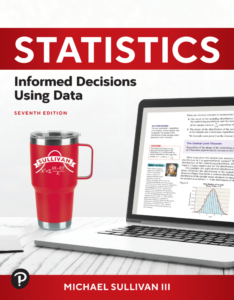
Statistics: Informed Decisions Using Data
Statistics: Informed Decisions Using Data 7e
This is the original text in the series. The seventh edition incorporates the latest methods in teaching introductory statistics. The goal is to provide the instructor with the utmost in flexibility while demonstrating the power of statistics to the student. Each example and exercise is carefully selected to demonstrate statistical concepts while engaging the student.
Sullivan's MyLab CourseID: sullivan31134
This course assumes the instructor is teaching inference using traditional methods and includes media assignments, suggested homework, practice exams with personalized homework, and exams. The media and suggested homework assume the use of StatCrunch. It would be easy to change this to another assumed technology (TI or Excel) or no technology at all. In addition, the homework includes applet exercises as well as the new MediaShare assignments.
Sullivan's MyLab CourseID (SBI): sullivan92592
This course assumes the instructor is teaching using simulation-based inference (SBI) and includes media assignments, suggested homework, practice exams with personalized homework, and exams. The media and suggested homework assume the use of StatCrunch. It would be easy to change this to another assumed technology (TI or Excel) or no technology at all. In addition, the homework includes applet exercises as well as the new MediaShare assignments.
Features and Resources
Technology-Specific Learning Aids in MyLab
Select MyLab exercises have learning aids (Help Me Solve This & View an Example) that offer technologyspecific help for StatCrunch (-SC), the TI-84 graphing calculators (-TI), and Excel (-E). Exercises in MyLab with the -SC, -TI, or -E designation will have learning aids that contain technology specific help for your students. For example, in Section 3.2, Problem 29-SC offers specific StatCrunch tech help; Problem 29-E offers specific Excel tech help; Problem 29-TI offers specific TI-84 tech help.
Threaded Problems
-
Tornado Problems Throughout the text a single, large data set that measures various variables on all tornadoes that struck the United States between 1950 and 2020 is utilized. The problems are marked with a icon. The table shows the sections, problems, topics covered and pages for the Threaded Tornado Problems. In addition, the author wrote corresponding MyLab problems around this data set. The problems may serve as a semester-long project for your students.
- Health and Nutrition Problems Threaded Health and Nutrition Problems Based on the feedback received from the threaded Tornado problems, the seventh edition now includes a corresponding threaded set of problems based on the National Health and Nutrition Examination Survey (NHANES) data obtained from the Centers for Disease Control and Prevention (CDC). The table on the front inside cover shows the sections, problems, and topics covered and pages for the Threaded Health and Nutrition problems. In addition, the author wrote corresponding MyLab problems around this data set. The problems may serve as a semester-long project for your students.
Putting It Together When students are learning statistics, they often struggle with seeing the big picture of how it all fits together. One of my goals is to help students learn not just the important concepts and methods of statistics but also how to put them together and see how the methods work together. On the inside front cover, you’ll see a pathway that provides a guide for students as they navigate through the process of learning statistics. The features and chapter organization in the seventh edition reinforce this important process. There are two categories of “Putting It Together.”
-
Putting It Together Sections appear in Chapters 5, 9, 10, and 11. The problems in these sections are meant to help students identify the correct approach to solving a problem. Many exercises in these sections mix in inferential techniques from earlier sections. Plus, there are problems that require students to identify the inferential technique that may be used to answer the research objective (but no analysis is required). For example, see Problems 26 to 32 in Section 10.5.
-
Putting It Together Problems appear throughout the text. The purpose of these problems is to tie concepts together and see the entire statistical process. For example, problems on hypothesis testing may require students to first identify the data collection method (such as observational study or designed experiment, the explanatory and response variables, the role of randomization, the role of control) prior to completing the data analysis.
Data
Click here for a chapter-by-chapter list of available data for download. The data is housed at Github. Curious as to how to house your data in Github? Click here.
There are many new lecture videos by author Michael Sullivan that have been updated to provide a detailed presentation of the material, improve audio quality, and address accessibility requirements.
Classroom Lecture Notes (Updated)
Classroom notes, which may be used by the instructor to deliver lectures to students. Students may print these notes out and bring them to the classroom, which facilitates good note-taking and allows them to focus on the concepts. The examples and activities in the classroom notes are different from those in the text and Instructor’s Resource Guide. New to this edition is the inclusion of examples that utilize responses to Sullivan's Statistics Survey III.
Student Activity Workbook
The student activity workbook now contains an outline for a semester-long project and suggestions for how to use the StatCrunch survey tool to develop a survey that could result in a semester-long project. Plus, there are fifteen new activities included in the activity workbook along with suggested answers in the corresponding instructor’s guide. These will also be delivered via MediaShare, allowing students to work collaboratively on projects with editable grading rubrics provided for instructors.
Student Resources
Data Sets, Formula Card, Applets, Technology Guides
Technology Step-by-Step
R Guidebook (Updated)
A Comprehensive Corequisite Solution
The MyLab course comes with a complete corequisite solution. The material is based on Michael Sullivan's Developmental Math Series. However, the material was rewritten so that it addresses the needs of the Introductory Statistics student.
Please view the Table of Contents of the complete text for the corequisite material.
The MyLab course includes both MyLab exercises and author-created lecture videos. It also has worksheets with additional exercises for every section.